
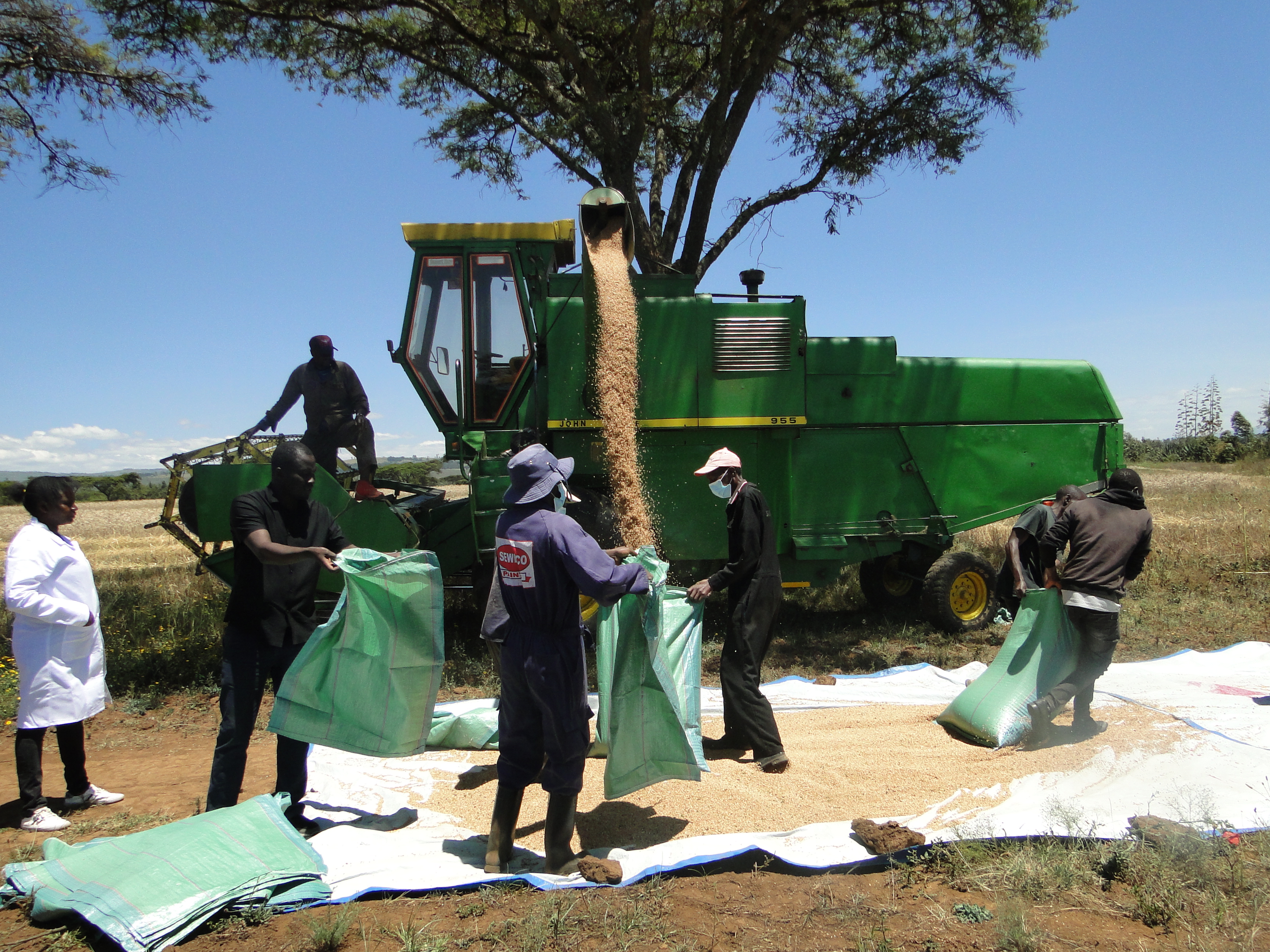
Wheat farmer returns to crop as Kenya seeks to close production gap
By William Inganga
When Vincent Chelule walks through his wheat field in Chesoton, Njoro, he sees more than a crop. He sees a family tradition, a business and a difficult calculation about whether wheat farming can still pay.
Chelule started growing wheat in 1994, following in his father’s footsteps. But six years later, he abandoned the crop after rising production costs and declining yields made farming increasingly difficult. He took time to learn what it would take to make wheat profitable before returning to the fields.
He has since carved a niche in seed production and bulking and now farms about 20 acres, rotating wheat with other crops. Last year, about half of his land was under wheat.
Despite more than three decades in the crop, however, Chelule says the biggest challenge remains the market.
“The major challenge for us as farmers is therefore the market,” he says. “The market exists, but the problem is the price.”
His experience reflects wider challenges in Kenya’s wheat industry. Wheat is the country’s second most important food cereal after maize, yet domestic production remains far below demand.
Kenya produced about 350,000 tonnes of wheat in 2024 against consumption estimated at between 2.2 million and 2.4 million tonnes, according to researchers at the Kenya Agricultural and Livestock Research Organisation (KALRO). More than three quarters of the country’s requirement is met through imports.
For farmers, however, increasing production is not necessarily matched by increased returns. Chelule estimates that producing an acre of wheat can now cost more than Sh50,000, driven by higher fuel and input costs.
At a selling price of Sh6,000 for a 90-kilogramme bag, a farmer needs more than eight bags per acre just to begin covering production costs.
Last year, Chelule planted two acres using about 100 kilograms of Njoro seed but harvested only about 20 bags after drought affected the crop. Under favourable conditions, he says, farmers can harvest between 18 and 25 bags an acre.
The market has also discouraged growers. Two years ago, some farmers struggled to find buyers after harvesting, with some storing wheat for months before selling at low prices. Chelule recalls holding about 200 bags at one point.
“Imagine harvesting in August and still having the wheat in your store in November,” he says.
KALRO wheat breeder Dr Martin Lagat says rising input, labour and land costs, coupled with subdivision of farms, have contributed to declining wheat production. As farms become smaller, mechanised production becomes more difficult and farmers increasingly compare wheat with other crops.
“Wheat prices in Kenya are low as compared to the cost of production,” Lagat says.
KALRO is responding through research and breeding of improved varieties. The Njoro research station, whose breeding programme dates back to the late 1920s, has released and registered 38 wheat varieties since 1975. Yield potential has increased from about 1.5 tonnes per hectare in 1975 to as much as eight tonnes per hectare for the latest varieties.
Chelule currently grows the Jacana variety, which he first planted last year and says performed well. His involvement in seed production began through a farmer-group project, followed by training, including a two-week course at Ol Joro Orok.
Seed production requires careful removal of off-types, spraying and other field operations. After harvesting, seed undergoes processing and inspection by the Kenya Plant Health Inspectorate Services (KEPHIS) before cleaning, dressing and packaging.
Disease remains another threat. KALRO’s international wheat phenotyping platform in Njoro, established in 2008 through collaboration with the International Maize and Wheat Improvement Center (CIMMYT) following identification of the Ug99 stem rust race, screens about 25,000 wheat lines for stem rust and yellow rust twice a year.
Plant pathologist Dr Zennah Kosgey says farmers should use certified seed and resistant varieties, scout fields early, practise good crop management and apply approved fungicides when necessary.
Weather variability is also putting pressure on farmers. Chelule says excessive rain initially affected germination this year before drought struck about a month after planting, when the crop was producing tillers.
KALRO is breeding varieties tolerant to water stress, acidic soils and low fertility, while researchers are exploring more efficient nutrient use. Lagat says irrigation could also expand wheat production by allowing farmers greater control over water and enabling development of additional wheat types.
For Chelule, however, science alone will not solve the problem. Farmers still need affordable inputs, reliable markets, adequate farmland and favourable weather.
He remains in wheat farming, but every season is another calculation. The seed must perform, the rain must arrive at the right time, diseases must be controlled and, after months of work, the grain must fetch a price that covers the cost of production.
For him, the future of wheat farming will ultimately depend not only on producing a better crop, but on creating conditions that make it worthwhile for farmers to keep planting it.