
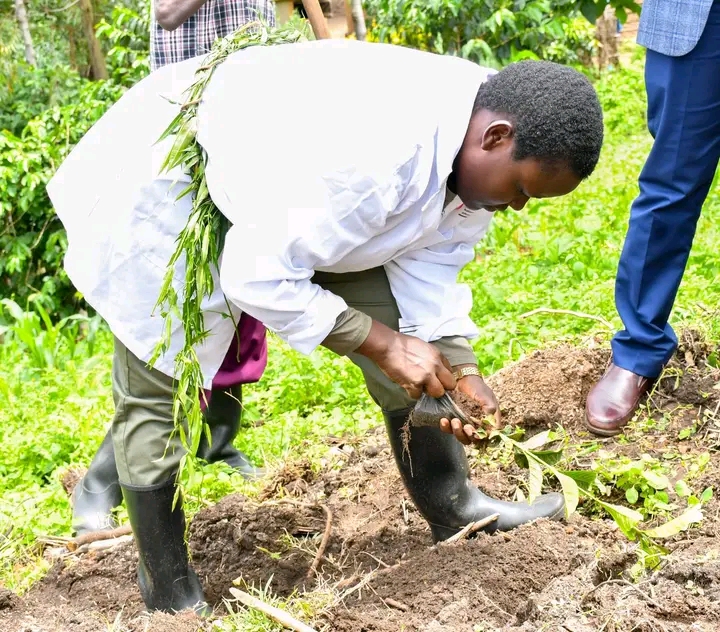
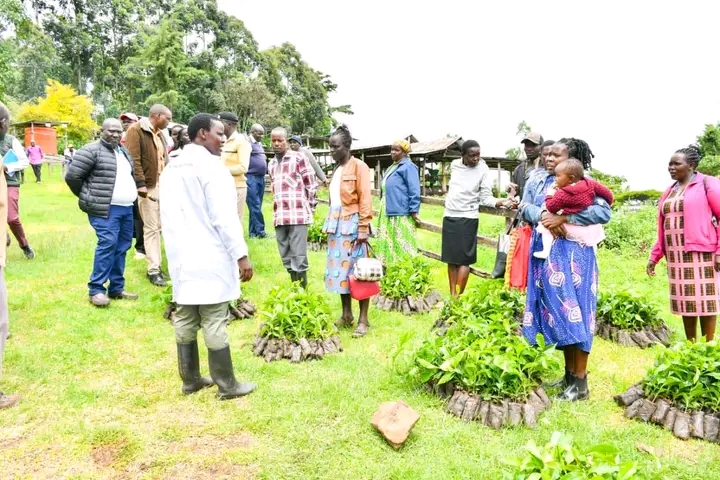
Tinderet women groups receive coffee seedlings
SAMMY MWIBANDA-KNA
Women groups in Tinderet Sub-County have received thousands of coffee seedlings as part of a major empowerment drive led by Nandi Woman Representative Cynthia Muge under the third phase of the “Mama na Kahawa” initiative.
The distribution exercise, held at Seiyot Cooperative Society, brought together dozens of women groups from across the sub-county, marking another milestone in the programme that seeks to economically empower women while reviving coffee farming in the region.
Speaking during the event, Muge said the initiative was deliberately designed to give women a stronger foothold in the agricultural value chain by enabling them to own and directly benefit from a high-value cash crop.
“This programme is about putting money in the hands of women,” she said.
“For a long time, women have provided labour on farms but had little control over the income. Through “Mama na Kahawa” we are changing that narrative by ensuring they plant, manage and earn from coffee,” she said.
She noted that since its inception three years ago, the initiative has recorded significant progress across Nandi County, with over 650,000 certified coffee seedlings distributed to women groups.
The programme has so far reached more than 4,000 women organized into at least 60 registered groups, many of whom are already reporting early gains from the crop.
According to Muge, the first phase of the initiative focused on awareness creation and initial uptake, during which about 150,000 seedlings were issued to approximately 900 women.
The second phase scaled up distribution significantly, with over 500,000 seedlings reaching more groups, while the ongoing third phase aims at deepening impact by increasing acreage and strengthening farmer capacity.
“In this third phase, we are not only expanding the number of seedlings but also focusing on sustainability,” she said.
“We are working closely with cooperative societies like Seiyot to ensure farmers have access to extension services, quality inputs, and reliable markets,” she said.
She emphasized that coffee farming has the potential to transform household incomes if properly managed, revealing that an acre of coffee can earn farmers up to Sh220,000 annually, depending on husbandry practices and market conditions.
“This is why we are encouraging our women to take this seriously. Coffee is not just a crop; it is a business that can educate children, build homes and uplift families,” she added.
Local agricultural officers present at the event underscored the importance of proper crop management, noting that the seedlings being distributed, mainly improved varieties such as Ruiru 11 and Batian, are high-yielding and resistant to common diseases.