
State unveils plan to expand irrigation, boost farm output
AKHAL LORUA-PCO
The State Department for Irrigation has launched the National Irrigation Sector Investment Plan (NISIP), a transformative roadmap aimed at accelerating Kenya’s food security agenda, boosting agricultural productivity, and enhancing climate resilience through expanded irrigation development.
The plan targets an increase in the area under irrigation from 664,000 acres in FY 2021/2022 to 1,289,142 acres by FY 2027/2028.
This expansion is expected to enhance agricultural output, create employment, raise household incomes and support the Government’s Bottom-Up Economic Transformation Agenda (BETA).
Water available for irrigation is projected to grow from 55.4 million cubic metres (MCM) in FY 2021/2022 to 2,379.2 MCM by FY 2027/2028, ensuring year-round water supply for farming.
Speaking during the Head of Public Service Monthly Meeting with Accounting Officers at Konza Technopolis, Principal Secretary for Irrigation, CPA Ephantus Kimotho, presented the status of irrigation development and highlighted key achievements and priorities in advancing national food security.
“Through strategic investments in irrigation infrastructure and enhanced water access, irrigated maize production is projected to rise from 0.2 million bags to 5.075 million bags,” said Kimotho.
“This expansion will cushion the country against climate shocks, strengthen food reserves and bolster national food security.”
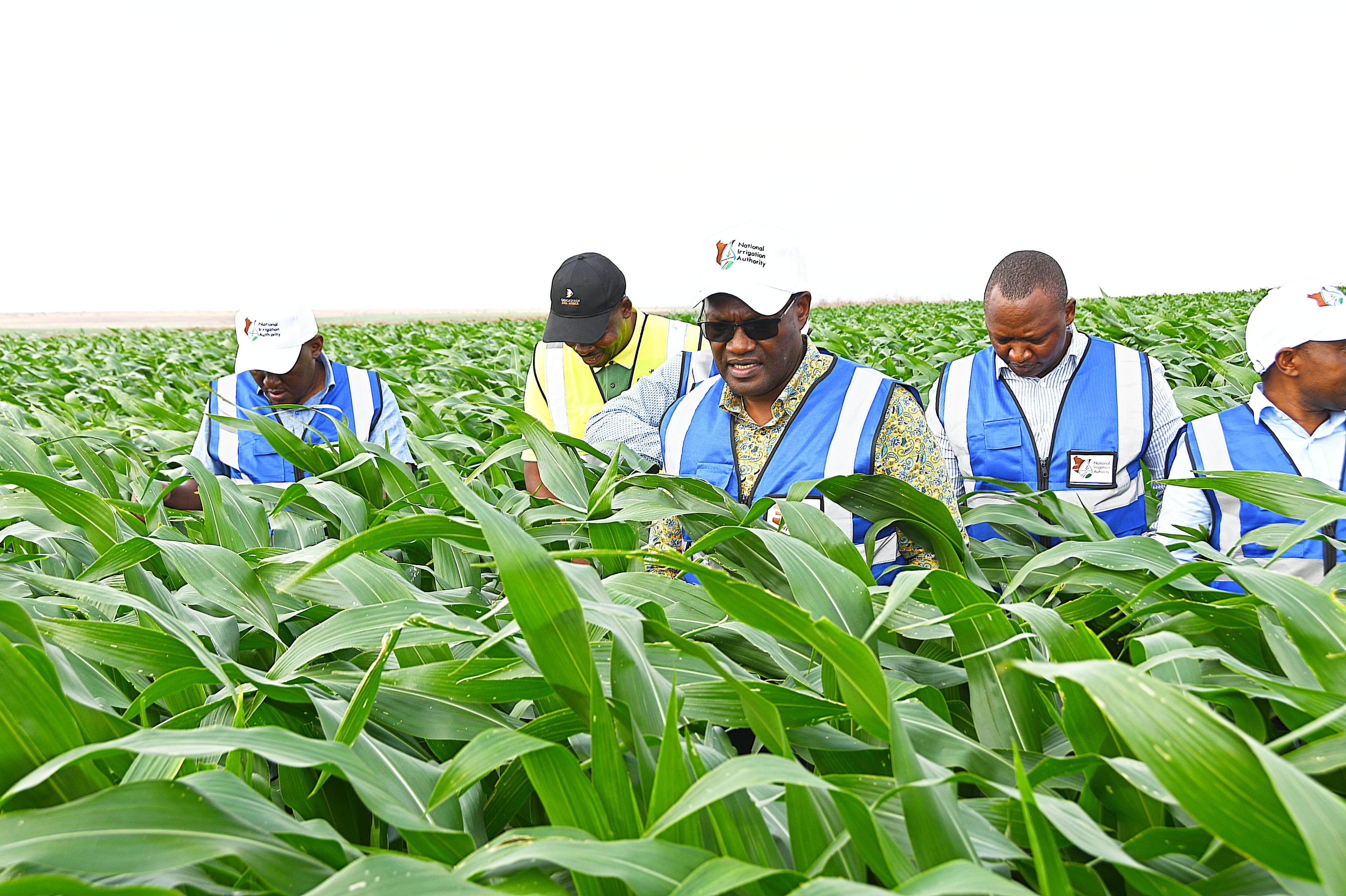
Under the maize value chain, he pointed out that the Department is providing reliable irrigation water to smallholder farmers while operationalizing the Galana Kulalu Food Security Project, which aims to produce over 14 million bags of maize annually from 200,000 acres under irrigation.
Key milestones include the construction of a major intake and reservoir with a capacity of 450,000 cubic metres.
Additionally, Project Nafaka is progressing in three phases, with the third phase targeting 20,000 acres within 30 months.
“The Galana Kulalu initiative will not only contribute significantly to food security but also attract foreign investment, create jobs, increase government revenue, and stimulate growth in agro-processing and manufacturing industries,” he emphasized.
On the rice value chain, the PS disclosed that the Department has committed to raising paddy rice production to 700,000 metric tonnes by 2027 through strategic irrigation investments and modernization of public schemes.
Interventions, he said, include converting schemes to gravity-fed systems, solarizing infrastructure to cut energy costs, rehabilitating 78,341 acres under existing schemes, and expanding an additional 27,500 acres for rice.
“Our goal is to increase rice production in public irrigation schemes from 305,000 metric tonnes to 570,000 metric tonnes, while commercialization of 35,000 acres will add another 420,000 metric tonnes annually,” noted Kimotho.
“Combined, these efforts will raise total rice production to about 990,000 metric tonnes, bridging the national deficit and reducing reliance on imports,” he said.
The Principal Secretary also highlighted progress in horticulture, where the Department is connecting over 100,000 farmers to irrigation water through community schemes and another 10,000 through farmer-led initiatives.
So far, he said that 50 community schemes have been completed, enabling irrigation on 60,000 acres, while 86 projects are ongoing.
“These schemes empower smallholder farmers by boosting productivity, diversifying crops, improving incomes, and creating jobs, particularly for youth and women,” he remarked.
Kimotho noted that further achievements include 143 completed community water pans and small dams, with 65 ongoing projects.
“Under the household water pans programme, 8,724 units have been completed and 160 are under construction. The Micro-Irrigation for Schools Programme has also made strides, with 66 projects completed and 31 ongoing, enhancing food production, nutrition, and agricultural learning in schools,” he added.
The PS said that other flagship initiatives include the Smallholder Irrigation Programme for the Mt. Kenya Region, expanded community irrigation schemes, and irrigation-supported fodder production programmes to strengthen livestock value chains and support feedlot development.