
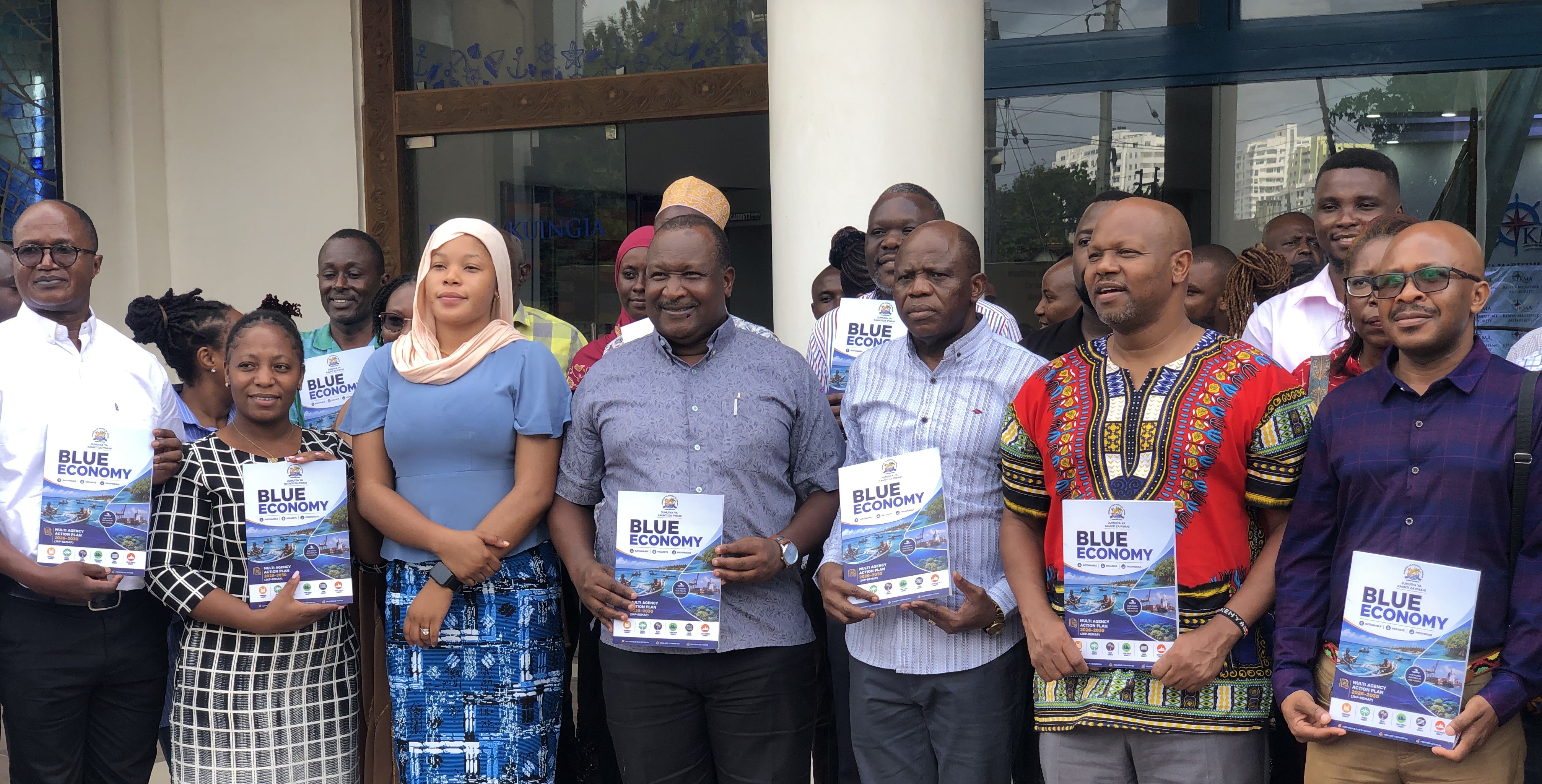
Coastal counties launch Sh156bn Blue Economy plan to create jobs
RAMADHAN NASSIB-KNA
Six coastal counties have launched a Sh156 billion ($1.2 billion) blue economy plan aimed at creating jobs, strengthening climate resilience and promoting shared prosperity for communities along Kenya’s coastline over the next four years.
The Jumuiya ya Kaunti za Pwani (JKP) Blue Economy Multi-Agency Action Plan (JKP-BEMAP) 2026–2030 was unveiled in Mombasa at the close of the Our Ocean Conference.
The plan brings together county governments, national agencies and development partners under a unified investment roadmap.
JKP Governors’ Forum Chairman Dhadho Godhana said the plan was developed through extensive consultations with local communities, county governments and technical experts, and will guide the region’s blue economy agenda over the next four years.
“This plan has involved all communities, all counties, all the technical teams, right up to the governors. Today, we have come to endorse it as the official plan for our programmes as a community of coastal counties,” he said.
The Tana River Governor said the coastal bloc had also rolled out a Blue-Green Bond targeting nearly $400 million to reduce its dependence on the national government and establish a sustainable financing base for coastal development projects.
“It is not about what others have done. It depends on what we want to achieve. It’s about how we make that progress,” Godhana said, urging Beach Management Units, SACCOs, conservancies and small traders to take advantage of the plan.
He said the Mombasa Agreement would help ensure benefits reach small-scale fishermen.
“When it comes to implementation, it is the counties, and within the counties, it is the people,” he said.
Kenya Maritime Authority (KMA) Director General Justus Omae Nyarandi said the agency had supported development of the plan and would continue monitoring its implementation.
“We will soon be supporting the people of the Coast in training around 15,000 coxswains. We want to recognise their prior learning and give them certificates so that we are able to increase safety in our waters,” Nyarandi said.
He added that the global shipping industry was shifting away from fossil fuels.
“As KMA we are exploring possibilities of having green energy, especially around our coast, so that we can be producers of green energy like hydrogen,” he said.
JKP Secretariat Chief Executive Officer Dr Emmanuel Nzai said the plan, developed with the National Government, targets bankable projects worth up to 1.5 billion US dollars, timed to align with Kenya Vision 2030.
“The President had a rallying call that we must organise ourselves, and a plan we already have. This is now the complete plan of Jumuiya ya Kaunti za Pwani in partnership with the National Government,” Nzai said.
He listed priority areas including marine transport, shipyards, fish ports, deep-sea fishing vessels, tourism infrastructure, and infrastructure to support planned special economic zones.
Blue Economy Technical Advisor Dr Edwin Ogumbo outlined the plan’s funding structure. “We expect 35 per cent of this fund from national government agencies.
County governments will contribute 20 per cent, giving us 55 per cent, meaning we already have enough to convince development partners to add another 20 per cent,” Ogumbo said, adding that private investors would then fund the remainder.