
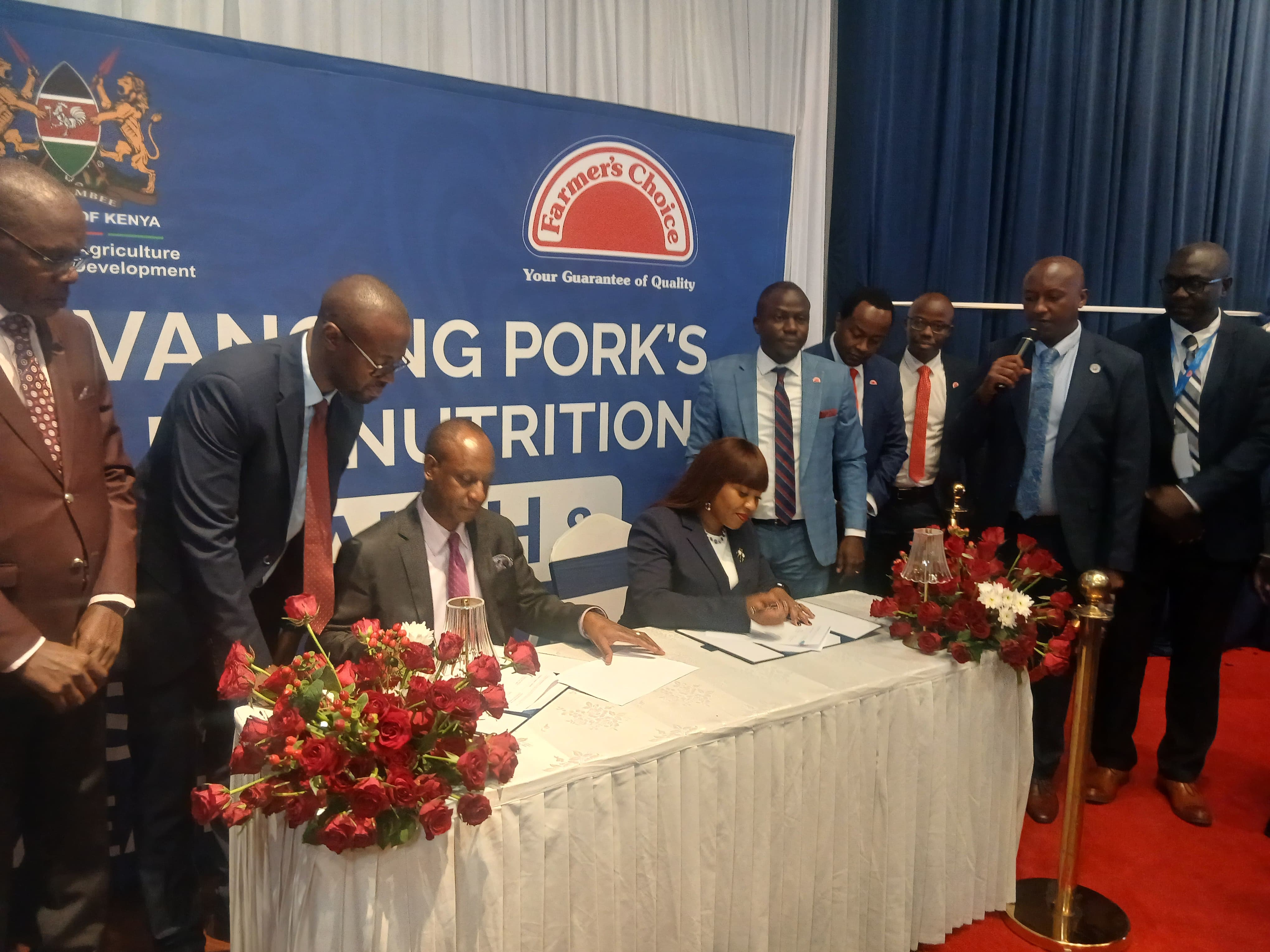
Kenya seeks to double pig industry output by 2030 in growth drive
ANITA KARIUKI AND NYAWIRA GITHINJI-KNA
Kenya has intensified efforts to transform the pig value chain, projecting 125 per cent growth by 2030 as the government moves to address production gaps, including high feed costs, weak market systems, and other structural challenges affecting the livestock sector.
Speaking during the National Stakeholders’ Sensitization Forum on the Pig Value Chain, the Principal Secretary for Livestock Development, Jonathan Mueke, said the sector presents a major opportunity for investment and growth in the country’s agricultural economy.
“The pig industry is one of the fastest-growing livestock value chains in our country,” Mueke said, noting that Kenya’s pig population currently stands at approximately 981,182.
He said annual pork demand in 2025 was estimated at 38,500 metric tonnes against a production level of 23,000 metric tonnes, with the sector valued at about Sh20 billion.
But, per capita consumption remains low at 0.4 kilograms compared to the global average of 0.8 kilograms.
Mueke observed that demand projections indicate consumption could rise by as much as 125 percent by 2030, describing the current figures as evidence of an under realized opportunities in the sector.
“These numbers tell a clear story; pork presents a significant under realized opportunity. The pig value chain contributes directly to household incomes and employment, especially for smallholder farmers who make up about 80 per cent of our producers,” he said.
The Principal Secretary noted that the sector plays a key role in supporting food and nutrition security, industrial growth, and job creation through processing, logistics and retail, and aligns with the Government’s Bottom-Up Economic Transformation Agenda (BETA).
He called for urgent expansion of production and value addition to meet rising demand, noting that changing urban consumption patterns present new opportunities for growth.
“Pork is a nutrient-dense food, rich in high-quality protein and important micronutrients such as iron, zinc and B-vitamins. It provides energy that supports active and productive livelihoods,” he said, adding that responsibly produced pork can help address malnutrition and improve dietary diversity.
Mueke, however, warned that the sector continues to face major constraints, including low productivity due to poor genetics and breeding systems, high cost of feeds, weak extension services, and limited farmer knowledge.
He further cited disease threats, particularly African swine fever, alongside biosecurity gaps that continue to cause heavy losses.
He noted that the industry rema i n s dominated by informal markets, with many farmers lacking access to finance, structured markets and processing facilities.
“Sustainability must be our guiding principle economically, socially and environmentally,” he said.
To address these challenges, the government outlined priority interventions aimed at strengthening the value chain. These include improving productivity through investment in quality breeds, affordable feeds.