
Relief for farmers as State moves to clear Sh6.8 billion coffee debt
SAMUEL WAITITU AND MUTAI KIPNG’ETICH-KNA
The Government has moved to clear Sh6.8 billion in verified coffee debts as part of a broader reform agenda to stabilize the sector and boost national production.
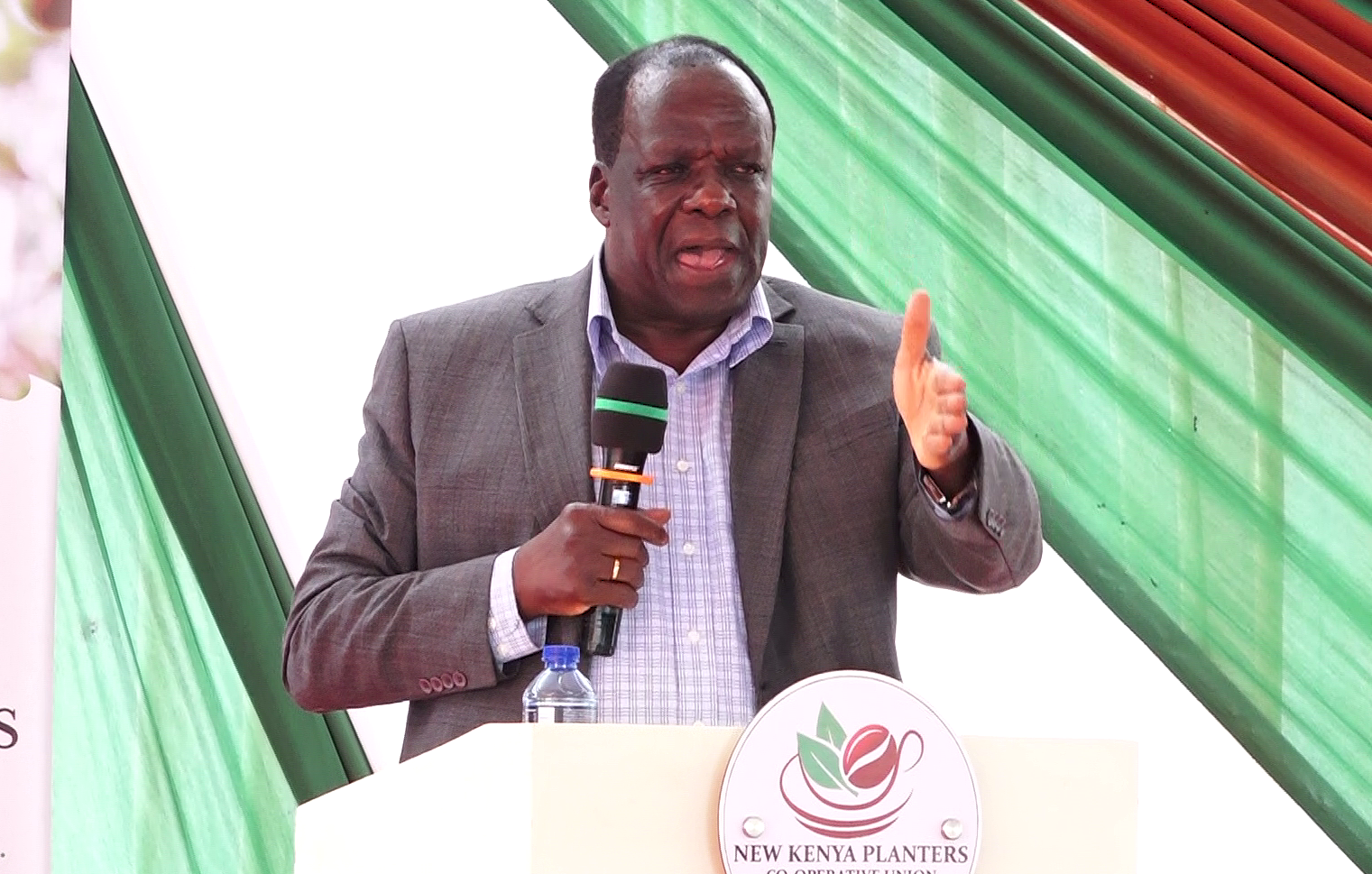
Cabinet Secretary for Cooperatives and MSMEs, Wycliffe Oparanya, announced that only audited and legitimate claims will be honoured, warning that fictitious loans will not be covered and could trigger prosecution.
Speaking to farmers in Embu and Kirinyaga, Oparanya emphasized that stringent verification mechanisms had been applied, ensuring that only debts backed by proper documentation and authorized minutes qualify.
“Any cooperative society whose debt is not reflected in the audited report will have to resolve those obligations internally,” he said, adding that Sh2 billion has already been set aside for the first phase of payments.
In a major policy shift, Oparanya barred cooperative societies from purchasing their own milling machines.
Instead, milling services will be centralized under the New Kenya Planters Cooperative Union (KPCU).
He argued that the move will cut costs, reduce idle equipment, and eliminate expenses tied to specialized staff, maintenance, and security.
“We want a scenario where any society in need of milling services will engage the New KPCU at a minimal fee,” he said, noting that shared services will lower processing costs for farmers.
The government has also prohibited cooperatives from seeking loans from commercial banks for inputs or cherry advances.
To cushion farmers, Oparanya highlighted the Cherry Advance Revolving Fund (CCARF) and Direct Settlement System (DSS).
Through CCARF, farmers can access affordable loans for inputs and household needs, while DSS ensures payments are deposited directly into farmers’ accounts within five days of coffee sales at the Nairobi Coffee Exchange.
“With these strategies in place, there is no justification for societies to borrow from commercial lenders,” he stressed.
Beyond debt relief, the government is targeting a tripling of annual coffee production from 50,000 metric tonnes to 155,000 by 2028.
Commenting on the expansion into new zones and increased acreage, Oparanya underscored coffee’s role as a key foreign exchange earner, saying reforms are designed to restore Kenya’s global competitiveness.
Principal Secretary in the State Department for Cooperatives, Patrick Kilemi, said Kirinyaga currently leads in coffee production and emphasized that embracing modern agronomic practices will be crucial in achieving national targets.
He noted that other counties such as Kakamega, Uasin Gishu and Trans Nzoia have shown increased interest in coffee farming, driven by rising demand for coffee seedlings.
This, he said, signals renewed confidence in the crop among farmers across the country. Kilemi added that the ongoing coffee revival programme requires the support and active participation of farmers.
He observed that reforms in the sector have revealed that challenges are not only within cooperative management but also across the broader value chain, including production, processing and marketing.
Kirinyaga County Governor Anne Waiguru urged the national government to fast-track waivers for Sh1.06 billion owed by 14 cooperatives in the county, including Karithathi, Rung’eto, Thirikwa, Ngiriambu, Rwama, Kanjuu, Mirichi, Inoi, Kibirigwi, Mwirua, Mutira, New Ngariama, Baragwi, and Kirinyaga Cooperative Union.
She said the debts weigh heavily on farmers and slow sector revival.
“Resolving the debt burden would complement gains already realized through reforms and investments across the coffee value chain,” she noted.
Waiguru highlighted Kirinyaga’s resurgence, with production rising from 28,000 metric tonnes in 2017 to 48,000, and farmer earnings climbing to Sh7.4 billion.
She credited deliberate county interventions in production, processing, storage, marketing, and value addition.
“Kirinyaga coffee is our pride and a legacy crop that continues to transform livelihoods,” she said.
Kirinyaga’s Arabica coffee continues to command global respect as Waiguru cited Kii Coffee Factory under Rung’eto Cooperative, whose AA-grade beans fetched Sh1,715 per kilo in 2023—the highest price in Kenya in five years.
She attributed such success to strategic investments in productivity and quality, including affordable seedlings from Kamweti Nurseries.
This season alone, 120,000 Ruiru 11 grafted seedlings were sold to farmers at Sh55 each, nearly half the private market price.
Coffee Revitalization National Steering Committee Chair, Peter Njeru Ndwiga, praised Kirinyaga’s cooperatives as among the best managed in the country.
He assured farmers that Kenya’s coffee brand will be elevated to compete with Ethiopia’s globally.