
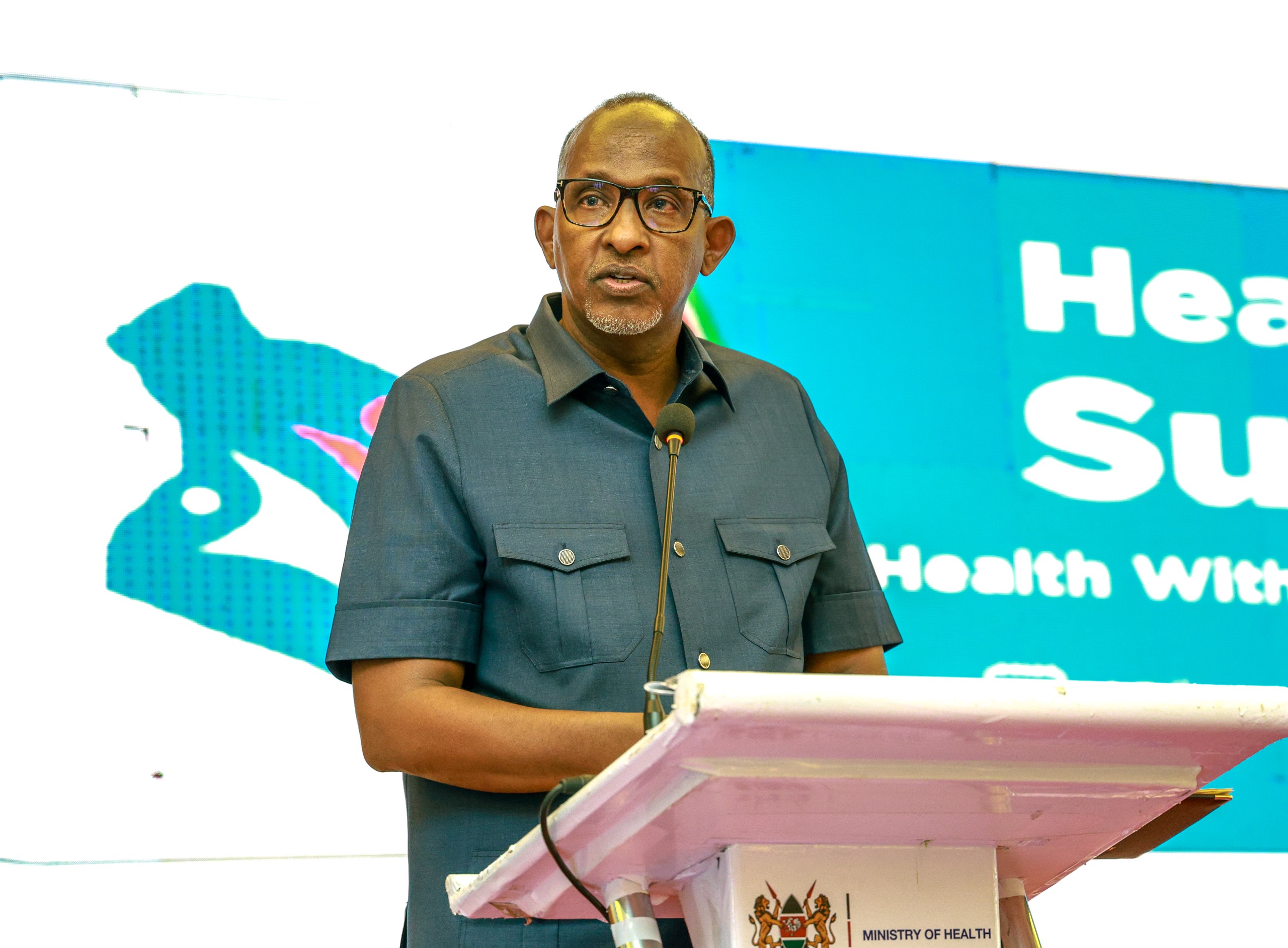
Kenya strengthens HIV fight through Universal Health Coverage integration
SADIK HASSAN-KNA
Kenya is bolstering Primary Health Care (PHC) as the backbone of its health system, integrating HIV prevention and treatment into a comprehensive care package as the country grapples with the world’s seventh-largest HIV epidemic.
Cabinet Secretary for Health Aden Duale said the holistic approach will enable the ministry to address comorbidities such as non-communicable diseases and mental health within the same care setting, improving efficiency and patient outcomes.
The CS noted that Kenya has recorded significant progress, achieving 97-87-83 toward the United Nations Programme on HIV/AIDS (UNAIDS) 95-95-95 targets.
The global targets aim to ensure that 95 per cent of all people living with HIV know their status, 95 per cent of those diagnosed receive antiretroviral therapy (ART), and 95 per cent of those on treatment achieve viral suppression by 2030.
“We remain vigilant against emerging challenges, including rising mother-to-child transmission rates and shifting international funding priorities,” said CS Duale in Mombasa during the opening of the Health Integration Summit 2026.
The high-level national summit, held under the theme “Health without Barriers for a Holistic HIV Response,” is convened by the Ministry of Health through the National AIDS and STI Control Programme (NASCOP).
It brings together government leaders, health professionals, development partners and civil society organisations.
The summit focuses on integrating HIV services into PHC and Universal Health Coverage (UHC) to ensure long-term sustainability for Kenya’s HIV response.
The CS observed that the global health financing landscape is shifting away from vertical, disease-specific programmes toward broader health systems strengthening.
“This transition is not a threat but an opportunity to re-imagine our approach. We must move beyond the parallel systems of the past, which, while effective for rapid scale-up, often resulted in high operational costs and fragmented care,” he said.
He affirmed that the ministry was anchoring the HIV response within the framework of Universal Health Coverage adding the transition to the Social Health Authority and the rollout of the Social Health Insurance Fund (SHIF) have so far recorded a remarkable enrolment of 29,952,890 Kenyans.
“We are expanding financial protection and ensuring that every Kenyan can access essential services without the fear of financial ruin,” the CS stated.
“Integration is the key to sustainability. By embedding HIV services within our domestic systems and SHIF benefit structures, we reduce fragmentation and optimize the use of our shared infrastructure and human resources.
"This is essential for safeguarding our progress as external donor support continues to evolve,” he added.
County governments were challenged to operationalize integrated service models and tailor health responses to local social and epidemiological realities, while the National Government remains a steadfast partner committed to enhancing coordination and aligning standards for the benefit of all citizens.
“As we pursue efficiency, let us remember that equity is non-negotiable. Our commitment to vulnerable populations, including women, adolescents and key populations, remains absolute.
"We must ensure that the transition to integrated care does not leave anyone behind, but instead brings services closer to those who need them most,” said Duale.
He noted that technological innovation will be a major driver of the envisioned progress, from digital health expansion to datadriven decision-making.
“We are adopting evidence-based tools to improve accountability and efficiency across all levels of government. A resilient health system must be an informed one,” he said.
To enhance health security and reduce over-reliance on external procurement of antiretroviral drugs and other essential health commodities, the government is also encouraging local manufacturing.
Duale also reaffirmed the ministry’s commitment to transparency and mutual accountability in the use of donor funds as the country moves toward increased domestic resource mobilization.