
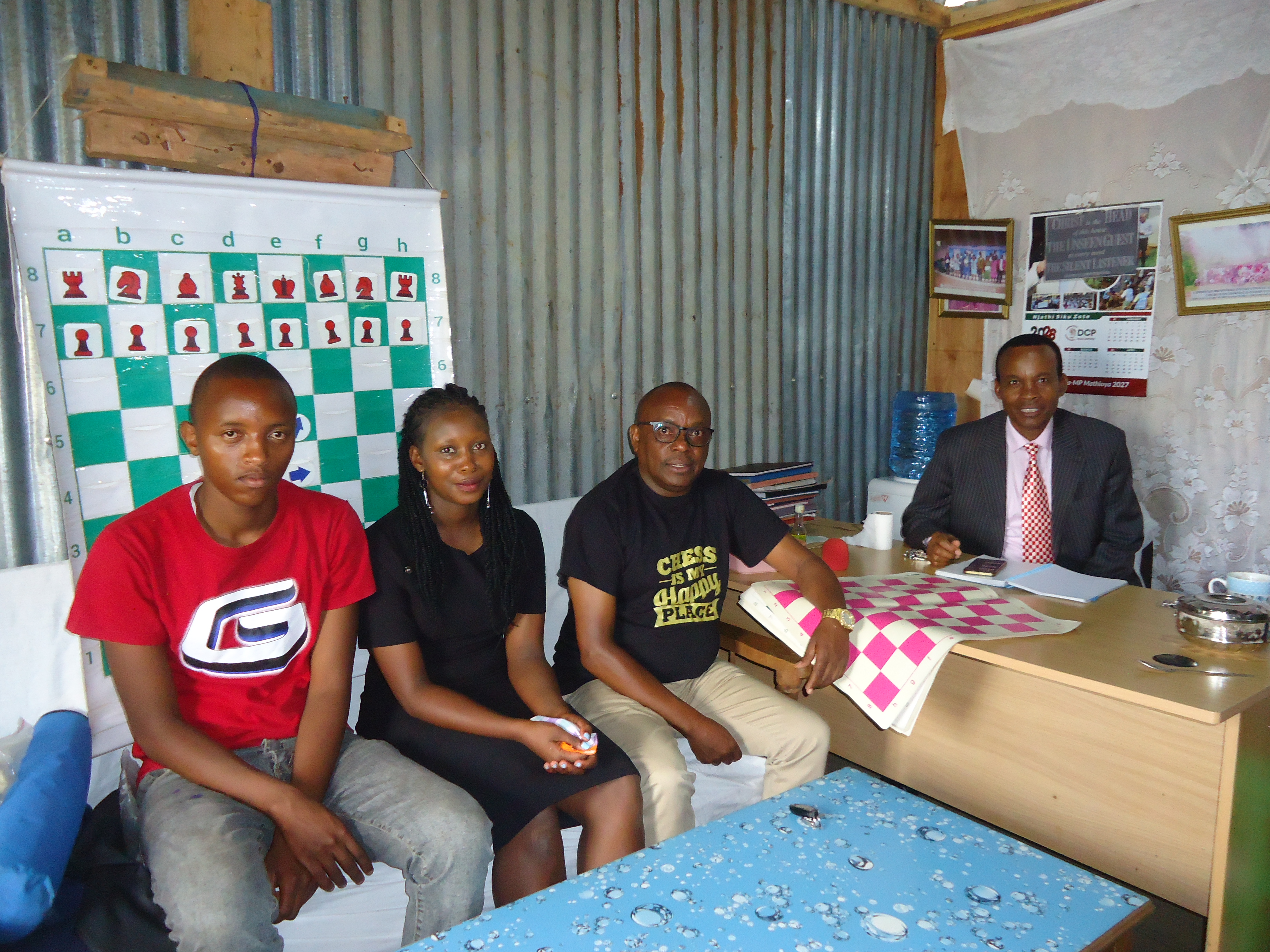
Young Kenyans turn to chess for new livelihood opportunities
ESTHER MBUTHIA-KNA
For many years, chess has often been seen as a game reserved for the elite, foreigners, or affluent communities.
In Kenya, it is commonly associated with wealthy families or the Indian community, leaving many young people from rural or modest backgrounds to believe it is beyond their reach.
However, Jane Wangari, a young woman from Kamune sub-location in Mathioya Sub-County, Murang’a County, has challenged that perception and is steadily changing the narrative.
Through determination, discipline, and the guidance of a dedicated mentor, she has risen through the ranks to become one of the country’s most promising chess talents.
Jane first gained national attention after qualifying to represent Kenya at the 20th edition of the African Individual Chess Championship held in Cairo, Egypt, from May 12 to 21 last year. Although financial constraints prevented her from making the trip, her achievement marked a significant milestone, proving that talent in chess is not confined to social class.
“The only difference between the rich and the poor in chess is opportunity,” Jane says. “When I qualified, my family and friends were not in a position to raise the money needed for travel, but I believe I will still get another chance.”
Her journey into chess began in an unlikely way. At the age of 14, Jane jokingly added the nickname “Talented” to her name, although she had not yet discovered what her talent was.
As the firstborn in a family of five, she grew up in a humble household and attended Kamune Day Secondary School, where she describes herself as an average student academically.
“My strength was never really in academics,” she admits with a smile. “But I always felt there was something I could do well.” Her turning point came in Form Two, when a new teacher, Joseph Kimani, was posted to her school by the Teachers Service Commission.
Unknown to many at the time, Kimani carried with him not only teaching skills but also a deep passion for chess.
Kimani had been introduced to chess during his time as a student at Kenyatta University, where he developed his skills under the guidance of a trainer who instilled discipline and resilience.
After graduation, he was posted to Brethren Day School in Laikipia East, where he attempted to introduce chess, but his efforts were unsuccessful as students preferred music.
A subsequent transfer to Tigithi Secondary School near Nanyuki Town did not yield better results. Despite the presence of a chessboard, administrative challenges made it difficult for him to establish a chess programme.
Frustrated but determined, Kimani sought a transfer back to Murang’a County, hoping to join established institutions like Murang’a High School or Kahuhia Girls High School, where he believed chess would thrive. Instead, he was posted to Kamune Day Secondary School, a relatively unknown institution.
Initially disappointed, he even considered declining the transfer. However, a conversation with the then County Director of Education, Mr Ng’ang’a, changed his perspective.
He was advised that while established schools already had structured clubs, Kamune offered him a blank slate to build both chess and music programmes from scratch.
“When I arrived, I realised this was an opportunity,” Kimani recalls. “I could shape something new.”
It was in this environment that Jane’s destiny began to unfold. When Kimani introduced chess at the school, Jane joined half-heartedly and later dropped out.
But Kimani, drawing from his own experiences, did not give up on her or other students who showed even the slightest interest. “I used gentle encouragement to keep them engaged,” he says.
“I knew that once they understood the game, they would love it.” Jane eventually returned to the game, and this time, she embraced it fully.
Her dedication began to pay off. Through rigorous training and participation in competitions, she steadily improved her skills.
In 2025, her efforts bore fruit when she won the Mount Kenya Region tournament and went on to triumph at the national level in her category.
This victory earned her a place in the Kenyan team for the continental championship in Egypt. Although she was unable to travel due to financial challenges, the experience strengthened her resolve rather than discouraging her. “I know I will still compete internationally,” she says confidently.
“This is just the beginning.” Jane completed her secondary education in 2025 but did not attain grades required for university admission. Undeterred, she now plans to pursue a course in tourism and hospitality at a college, even as she continues to build her career in chess.
Today, Jane is not only a player but also a trainer. She works alongside her mentor to teach chess at various schools across Kamacharia Division and beyond, including areas as far as Kenol in Maragua Sub County.
Kimani, recognising the growing interest in the game, established the Chess Masters Club, where he serves as Founder and Director.
Jane plays a key leadership role as the principal trainer, mentoring young learners and helping expand the club’s reach.
On March 14 this year, the club facilitated the participation of 77 players in the 56th Mount Kenya Regional Championships held at Bishop Gatimu Ngandu Girls High School in Nyeri County.
All participants qualified for the national championships scheduled for April at Mang’u High School. Jane takes pride in the achievements of her trainees, including her own siblings.