
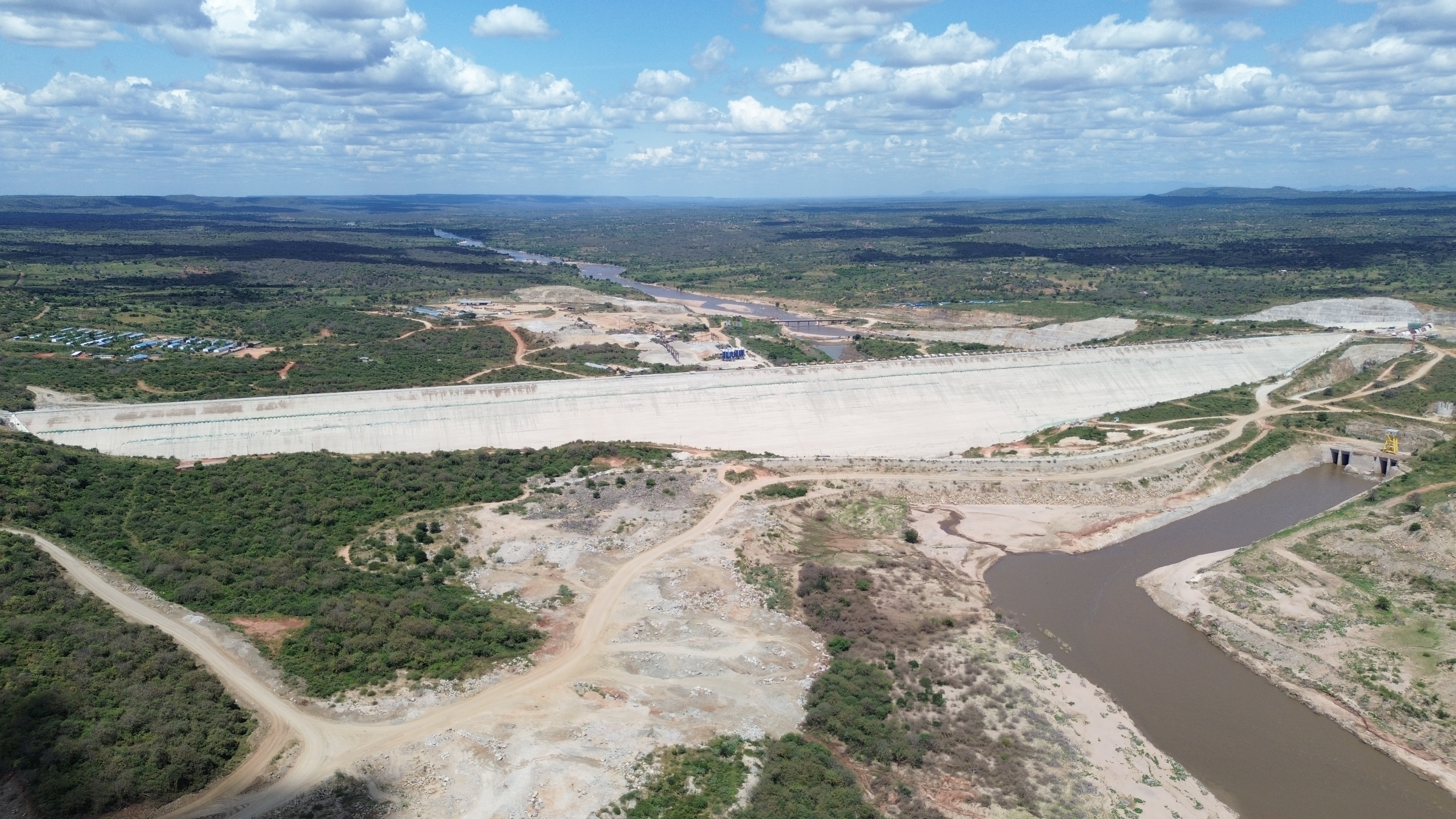
Ruto hails Thwake Dam as game-changer for food security in Lower Eastern Kenya
PATRICK NYAKUNDI-KNA
President William Ruto has championed the Thwake Multipurpose Dam as a cornerstone of his Bottom-Up Economic Transformation Agenda (BETA), describing irrigation as the most transformative intervention in Kenya’s agricultural sector.
He said the Thwake Dam will serve as a lifeline, securing food production, protecting millions from drought, powering new industries, and transforming Lower Eastern Kenya from a region defined by scarcity into a hub of opportunity.
Across the sun-scorched plains of Makueni, Kitui, and Machakos counties, families have long endured arduous journeys in search of water, while farmers have watched their crops wither under erratic rainfall and communities have lived under the constant threat of drought.
Supported by the Government of Kenya and the African Development Bank (AfDB), the project is among the country’s largest water infrastructure investments.
Once completed, the Thwake Dam—an 80.5-metre-high concrete structure designed to hold 688 million cubic metres of water—will be the largest reservoir in Kenya and one of the biggest in Africa.
“Water is life,” President Ruto has repeatedly emphasized, linking the Thwake project directly to the government’s agenda of expanding irrigation and strengthening resilience against climate-related shocks.
President Ruto has argued that irrigation is “the ultimate solution in guaranteeing food security in our country,” a statement that resonates deeply in a region where rainfall has too often dictated fortune and failure.
Thwake is expected to supply 150,000 cubic metres of treated water daily to about 1.3 million people across Makueni, Kitui, and Konza Techno City in Machakos.
For households, this means clean water closer to home, less time spent walking long distances, and more time for school, work, and enterprise.
Women and children, who have carried the heaviest burden of water collection, stand to gain immediate relief.
Phase four of the programme will irrigate 40,000 hectares, roughly 100,000 acres, opening the door to repeated planting seasons, higher yields, and stronger local markets.
“We must move from rainfed agriculture to irrigation-fed agriculture,” Ruto said, underscoring his belief that Thwake is the missing link between fertile soils and actual productivity.
The dam’s potential stretches beyond agriculture, plans include a hydropower component with an installed capacity of 20 megawatts, sanitation and wastewater systems, and industrial water supply.
For Konza Techno City, Kenya’s flagship smart city project, Thwake is indispensable. Its long-term expansion depends on dependable water systems, and the dam is set to deliver exactly that.
In this way, Thwake bridges rural development with national modernization, tying the fate of smallholder farmers to the ambitions of a digital economy.