
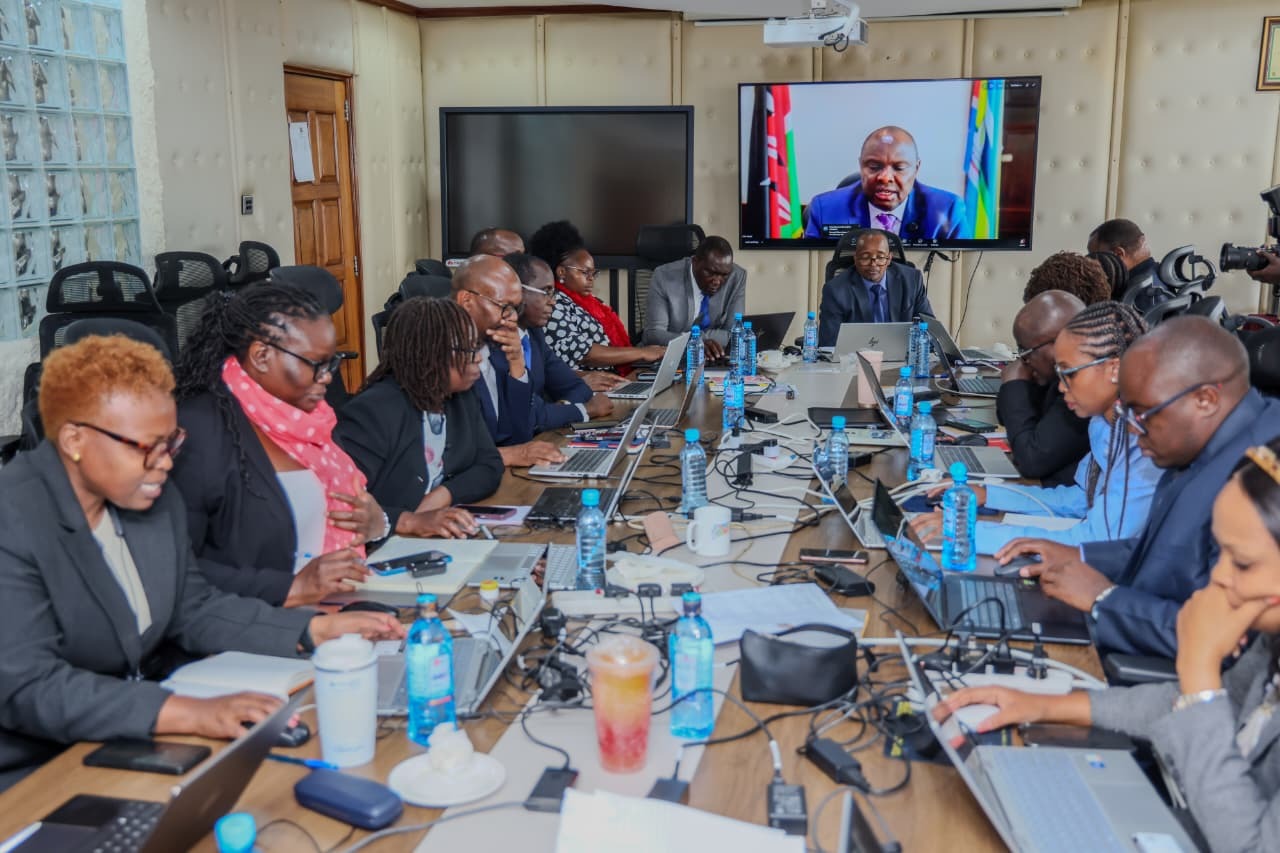
Public service boss pushes accountability integrity, efficiency in transport services
NELLY KOSGEY-PCO
Chief of Staff and Head of Public Service, Felix Koskei, has directed staff in the State Departments of Roads and Transport to uphold integrity, accountability, and efficiency in service delivery.
Koskei underscored that procurement, project implementation, enforcement and service delivery must reflect the highest standards of transparency and impact.
“Every road constructed, every kilometre maintained, every transport system regulated, and every safety measure implemented has a direct impact on productivity, connectivity and national development,” he said.
He urged staff to shift from routine processes to results-driven approaches, emphasizing quality, timeliness, and reliability over sheer project numbers.
The Head of Public Service further warned against institutional silos, insisting that planning, construction, maintenance, regulation, and enforcement must operate as one coordinated system.
Fragmentation, he noted, weakens efficiency and undermines impact.
He also called for citizen-centred service delivery, where the government’s work is felt through safe roads, orderly transport systems, reduced congestion and reliable services.
“There must be zero tolerance for wastage, inflated costs, or misuse of public funds,” Koskei declared, stressing prudent resource management and stronger monitoring and evaluation mechanisms.
In remarks delivered on his behalf, Roads Principal Secretary Eng. Joseph Mbugua highlighted significant achievements in the sector over the past three years.
The PS reported that approximately 2,700 kilometres of road network had been upgraded to bitumen standards, improving connectivity to markets, schools, health facilities, and economic opportunities, particularly in underserved regions.
Completed projects include urban link roads easing congestion in major towns, rural access roads opening up agricultural zones, and strategic corridors strengthening inter-county and regional connectivity.
Eng Mbugua pointed to flagship projects such as the Rironi–Mau Summit section of the A8 corridor, spanning 175 kilometres along the Northern Corridor, which is advancing under a structured framework to ensure timely delivery and high-quality standards.
He also cited the Horn of Africa Gateway Development Project, covering 750 kilometres along the Isiolo– Wajir–Mandera corridor, which is expected to open up Northern Kenya and enhance regional trade and investment opportunities.
Looking ahead, the State Department is implementing an ambitious programme targeting 28,000 kilometres of roads to bitumen standards and dualing 2,500 kilometres over the next decade.
Eng Mbugua added that digital transformation was being embraced, with Intelligent Transport Systems improving traffic management and digitized weighbridge operations strengthening axle load control and compliance.
Transport Principal Secretary Mohamed Daghar outlined strides made in positioning Kenya as a regional transport and logistics hub.
He cited the ongoing development of the Standard Gauge Railway (SGR) from Naivasha to Kisumu and Malaba, launched in March 2026, alongside the expansion and modernization of commuter rail services.
New lines include Nairobi–Ruiru–Thika, Nairobi–Kikuyu–Limuru, Riruta–Ngong–Kiserian– Rongai, and the Miritini SGR Station to Mombasa CBD, as well as the Voi– Taveta MGR line.
Daghar noted that additional rolling stock had been acquired to optimize Inland Container Depot operations, facilitating cargo movement and decongesting the port of Mombasa.
The port itself recorded a 10 percent increase in cargo handling, rising from 40 million metric tons in 2024 to 45 million in 2025.