
WRA releases Sh49.9 million to boost Mwache watershed conservation efforts
CHRISTINE CHERYL-MYGOV
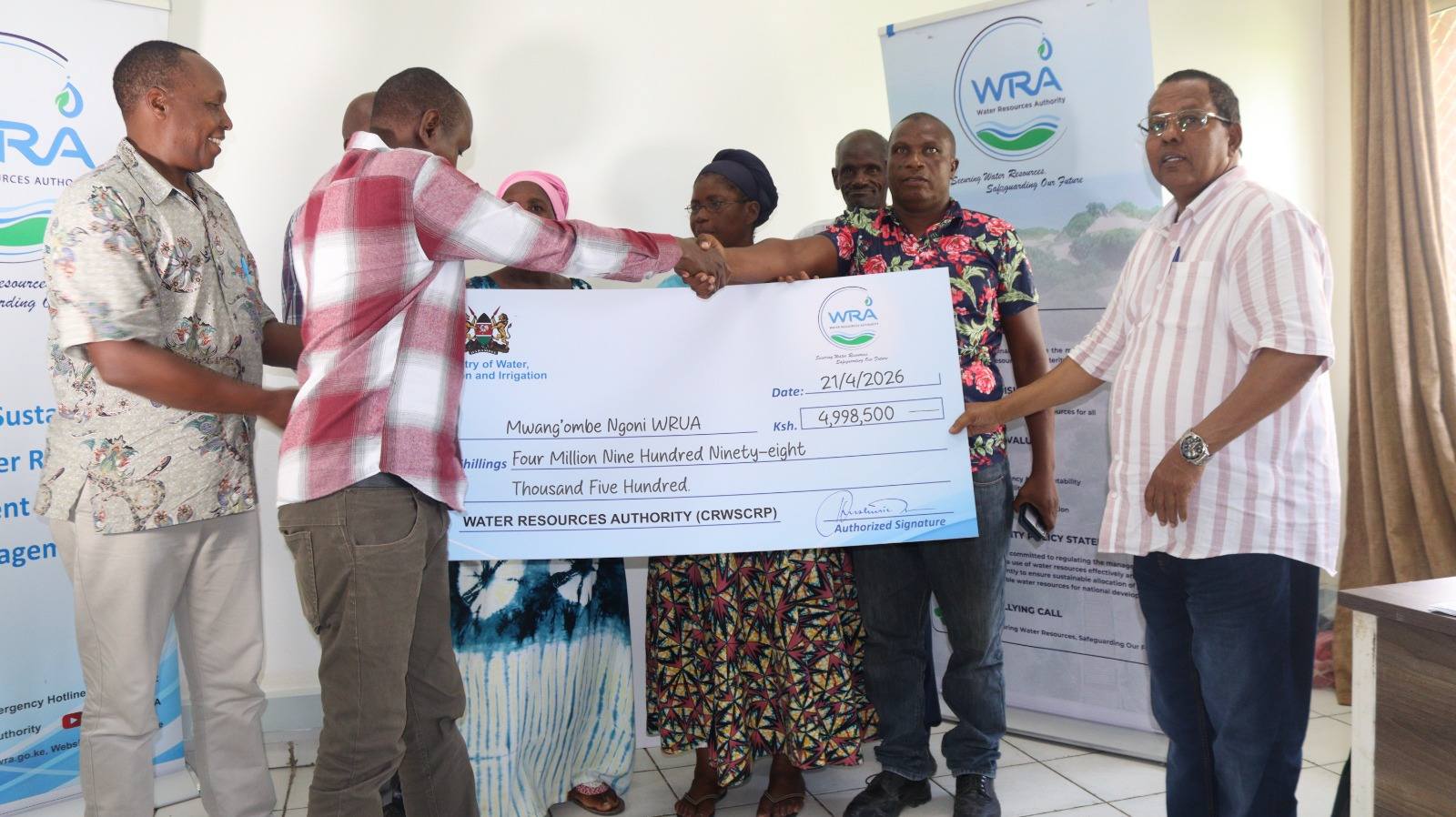
Community conservation efforts in the Mwache watershed have received a boost after the Water Resources Authority (WRA) disbursed Ksh 49.9 million to the Water Resource Users Associations in Kwale, Kilifi and Taita Taveta counties.
WRA CEO Mohamed Shurie said the funding is part of the Coastal Region Water Security and Climate Resilience Project, which supports the broader Mwache Multi-Purpose Dam Development Project under Kenya Vision 2030.
The WRUAs benefiting from the latest Sh49.9 million include Mwachiga, Mazola Mienzeni, Upper Mwache, Mwang’ombe Ngoni, Marenje Mulunguni, Mulunguni, Chigulu Ngeyeni, Nyongoni, Gude Dambale, and Mwadudua Vigurungani.
“The Mwache Dam, situated in Kwale County, is expected to supply 186 million cubic meters of water daily to Mombasa, Kilifi, and Kwale.”
“It is envisioned as a lifeline for the coastal region, providing water for domestic use, irrigation, and economic development. Yet the dam’s sustainability has been threatened by catchment degradation, erosion, and sedimentation, which risk shortening its lifespan and undermining food security for local communities,” said Shurie.
To counter these challenges, the CEO pointed out that the Authority has turned to Water Resource Users Associations, grassroots institutions that serve as custodians of local water governance.
He said that WRUAs are tasked with implementing catchment management activities, promoting sustainable water use, and ensuring equitable access to water resources.
“By channeling funds directly to these associations, the Authority hopes to empower communities to take ownership of conservation and livelihood projects.”
“This latest disbursement brings total funding to WRUAs in the Mwache catchment to Kshs 135.485 million. Earlier Sh85.5 million had been allocated to 25 WRUAs.
The money supports both conservation and income-generating activities, ensuring that environmental protection is tied to tangible community benefits,” said the CEO.
He said that the Authority has already recorded significant that community participation remains central to the project’s success adding that local groups are key to implementing sustainable land and water management practices.
“Despite challenges posed by climate variability and extensive catchment degradation, the Authority, working with the World Bank and other partners, remains confident that the project will deliver long-term environmental and socio-economic gains,” said Shurie.
The Mwache project, he said, beyond securing water supply, it will reduce sedimentation that affects critical infrastructure such as Mombasa Port, lower water treatment costs and improve livelihoods across the coastal region.
He said that ongoing activities target erosion-prone hot spots with interventions ranging from afforestation and drainage line treatment to water harvesting and agricultural conservation practices.
The CEO emphasized achievements, a physiographic survey of the Mwache catchment has been completed and 24 WRUAs have been mobilized with Sub-Catchment Management Plans developed.
The CEO noted that a comprehensive Mwache Catchment Management Plan is in place, and 2,360 hectares have been rehabilitated through community-led approaches.
He added that sustainable land management practices, farmer field schools, and farmer-led irrigation initiatives have also been integrated into the project.
Commenting on concrete results from earlier funding, Shurie disclosed that communities have constructed 54 kilometers of terraces, pegged and marked 91 kilometers of riparian land, and built over 1,200 meters of gabions.
He said that six acres of vetiver bulking sites have been established, and 27,000 indigenous and fruit trees planted whereas livelihood projects have flourished, including poultry keeping, goat rearing, beekeeping, and aloe vera and green gram farming.
By December 2025, 1,050 hectares of land had been conserved; sediment monitoring stations have been set up and the Mombasa Sub Basin Office Laboratory refurbished for sediment analysis.
The Mwache project, he said, beyond securing water supply, it will reduce sedimentation that affects critical infrastructure such as Mombasa Port, lower water treatment costs and improve livelihoods across the coastal region.
He said that ongoing activities target erosion-prone hot spots with interventions ranging from afforestation and drainage line treatment to water harvesting and agricultural conservation practices.
The CEO emphasized that community participation remains central to the project’s success adding that local groups are key to implementing sustainable land and water management practices.
“Despite challenges posed by climate variability and extensive catchment degradation, the Authority, working with the World Bank and other partners, remains confident that the project will deliver long-term environmental and socio-economic gains,” said Shurie.