
State accelerates mangrove recovery along Coast under tree-planting plan
CHARI SUCHE-KNA
The Government has stepped up efforts to restore degraded mangrove ecosystems along the Coast in support of the national campaign to plant 15 billion trees by 2032.
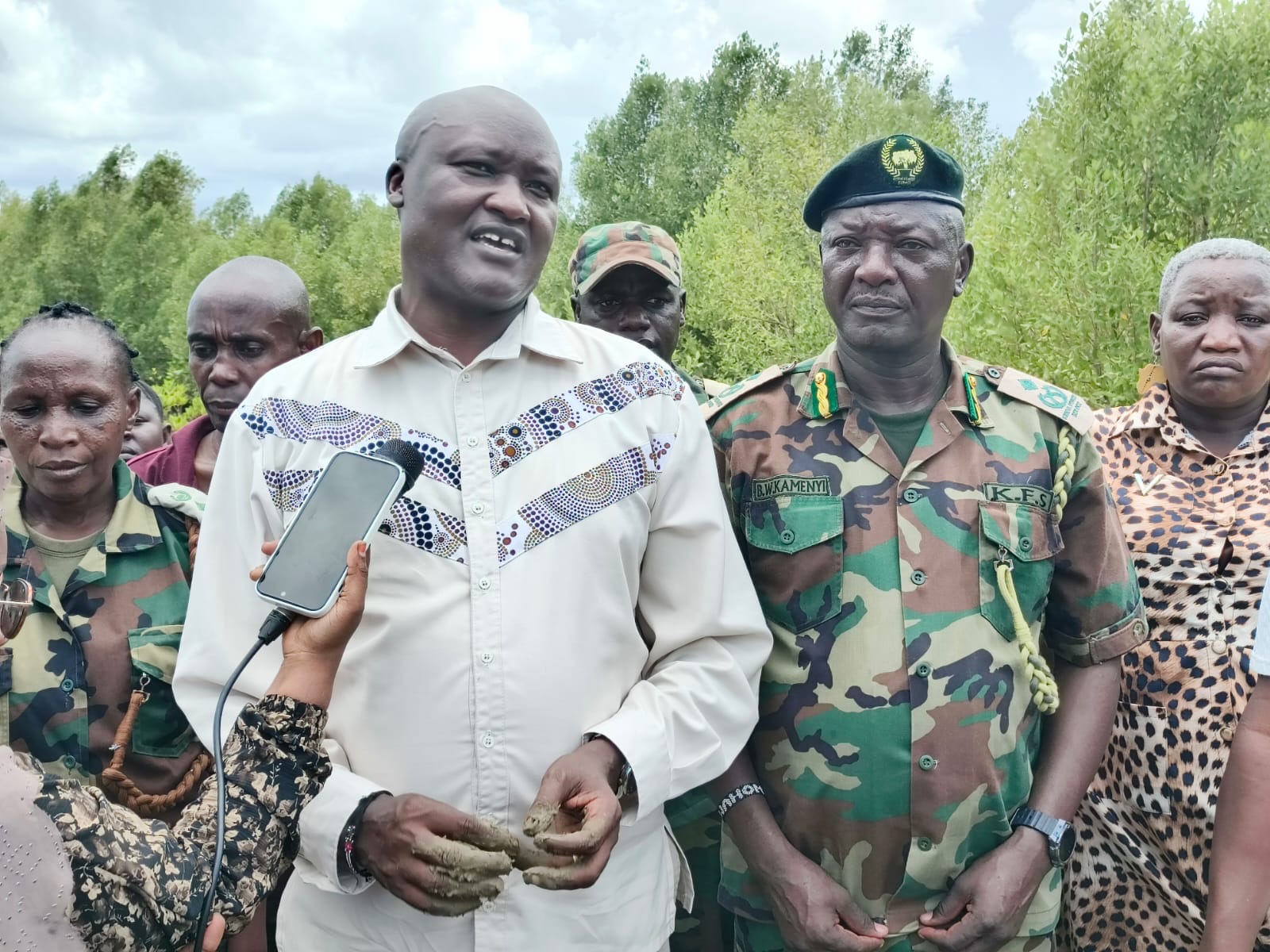
Speaking during a mangrove planting exercise at Miritini in Mombasa County, the Conservation Secretary, the State Department for Wildlife, Dr. John Chumo, said the initiative aims to boost Kenya’s forest cover from below the constitutional threshold of 10 per cent to at least 30 per cent.
“We are here to restore critical habitats, particularly mangrove ecosystems, which play a vital role in environmental conservation. As a country, we must increase our forest cover, and mangroves are central to achieving this goal,” Chumo said.
He noted that mangroves are more efficient in carbon sequestration compared to terrestrial forests.
“If you compare one square meter of mangrove to terrestrial forest, mangroves absorb up to five times more carbon. This makes them key in mitigating climate change,” he explained.
Chumo added that mangroves also act as natural water purifiers and help reduce soil erosion by slowing down water flow before it reaches the ocean.
Additionally, he emphasized that mangrove forests serve as breeding and nursery grounds for over 1,500 species, including fish and crustaceans, making them essential for marine biodiversity.
The government plans to plant at least 10,000 mangrove seedlings in the area during the current phase, with more planting exercises expected in the future.
Mombasa County Forest Conservator, Bernard Wahome, said about 40 per cent of the county’s 423.15 hectares of forest cover is degraded, underscoring the need for urgent restoration.
“It is our duty to rehabilitate these degraded areas. Mangroves sequester carbon up to four times more than terrestrial forests, so restoring them has significant environmental benefits,” Wahome said.
He added that the programme is also promoting nature-based enterprises such as beekeeping, fish farming, and ecotourism to reduce pressure on forests while improving community livelihoods.
Wahome identified illegal mangrove harvesting and illicit local brew activities as key threats, but noted that authorities are addressing them through a multi-agency, approach involving security teams and local communities.
Community Forest Associations (CFAs), have been instrumental in conservation efforts. John Nyamwaya, a representative of the Mombasa Kilindini Community Forest Association, said the group works closely with the Kenya Forest Service (KFS) to protect mangroves across key areas, including Tudor Creek, Port Reitz Creek, and Mtwapa Creek.