
Interior Ministry links infrastructure push to security gains
HAMISI JUMA-MYGOV
The Ministry of Internal Security and National Administration has said that the ongoing infrastructure projects across Western and Nyanza regions are not only about development but also about strengthening national security.
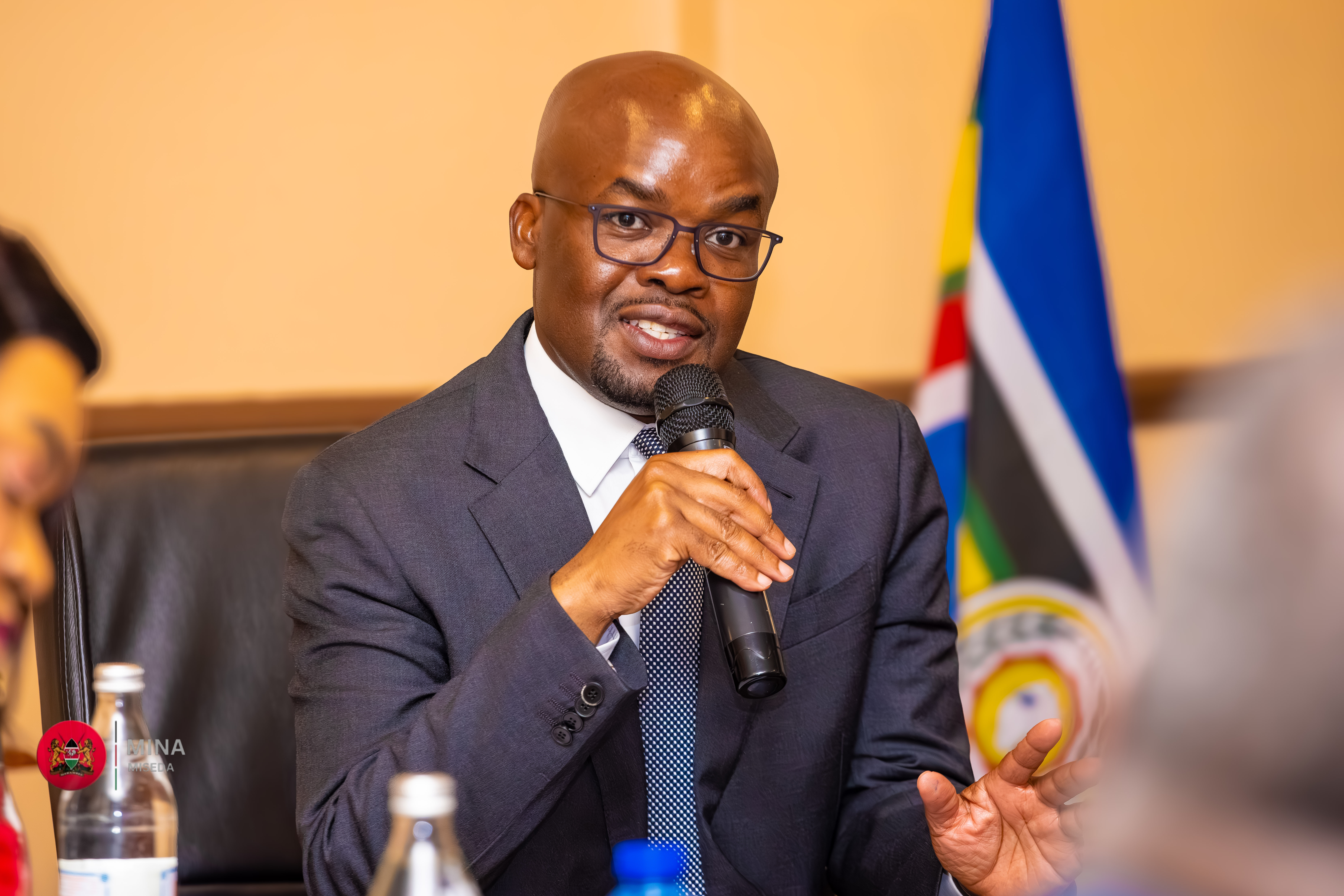
Principal Secretary for Internal Security and National Administration Dr. Raymond Omollo noted that the review of the Wildlife Conservation and Management Act 2013 and the commissioning of new roads, markets, and public facilities are part of a deliberate strategy to close spaces where insecurity thrives.
“Where roads do not reach, governance struggles to follow. Where communities are isolated, criminal networks find room to operate. These investments are as much about closing spaces that breed insecurity as they are about opening opportunity,” Dr. Omollo told reporters.
Dr. Omollo highlighted the newly built Mundere Okando–Sio Port–Nangina road in Budalangi, saying it will provide families yearround access to markets, schools, and health facilities.
Beyond convenience, he stressed, such roads enhance the mobility of security agencies. “A road that allows a fishing family to reach a market more quickly is the same road that allows a County Commissioner to respond to an incident or a police unit to deploy where it is needed,” he said.
The PS pointed to several projects commissioned by President William Ruto during his Western Region Development Tour. These include: Busia Stadium and the Kenya Medical Training College’s Teso Campus, which expand youth opportunities and reduce marginalisation. In Narok, the laying of the foundation stone for the SGR Naivasha–Kisumu line was described as transformative for both trade and security.
Faster rail access, Dr. Omollo said, will allow rapid deployment of security resources and reduce vulnerabilities along the corridor.
In Kisumu and the wider Nyanza region, landing sites in Asat and Nyandiwa and the development of Usenge Pier are being formalised to strengthen the blue economy.
Dr. Omollo explained that unregulated landing sites have historically been entry points for contraband and trafficking networks.
“By bringing these sites under structured governance, the state reduces the vulnerabilities that bad actors exploit,” he said.
The PS added that alongside infrastructure, the government is empowering chiefs, assistant chiefs, and county commissioners with resources and digital tools to extend state presence to the grassroots.
“Through these officers, the government has enhanced security coordination, disaster response, and implementation of national programmes at the community level. The visibility of government and the trust it builds is itself a deterrent to instability,” he said.
Dr. Omollo emphasised that the interventions across Busia, Bungoma, Vihiga, Kakamega, Kisumu, Siaya, Homa Bay, Migori, Kisii, and Nyamira are coordinated and multi-sectoral.
“It is not piecemeal development. It is the deliberate closing of the gaps that insecurity requires to survive: the gaps in infrastructure, in services, in economic opportunity, and in the reach of the state,” he said.
He concluded by stressing that security is not achieved by enforcement alone but by building conditions for safe and dignified lives.
“We remain focused on sustaining this momentum, deepening service delivery, empowering our administrative structures, and ensuring that every Kenyan lives not just under government, but within its protection,” Dr. Omollo said.